The Gladesville Master Plan
Gladesville Shopping Village is ugly. You would struggle to find a resident who isn't excited about the prospect of a knockdown rebuild. The community is now faced with a very real opportunity to see Gladesville rejuvenated, but the cost of that dream may not be worth it.
Hunters Hill Council were given a target to deliver 400 new homes by 2029. Council determined the best way to meet this goal is to build apartments.
522 apartments.
All on one block.
It's very attractive when you look at it if you're a member of Council. You've been given a goal to meet 400 new dwellings in the Hunters Hill LGA and there's this ageing shopping centre up the road bursting with opportunity for redevelopment. This becomes really easy, knock down the eyesore and build some apartments and you're on your way to hitting your housing target. Not all of the target though, just some of it. Putting all 400 new dwellings on the shopping village block is not possible because of Floor Space Ratio (FSR) and building height limitations.
This is the current topic open for public exhibition with Hunters Hill Council. In order to build 522 new apartments on the shopping village site they need to submit a planning proposal to the NSW Government that creates a permanent FSR limit increase for the zoned area from 1.3:1 to 4:1 and raises the permissible height. This is a massive increase to the current FSR which would limit a development to roughly 175 apartments.
Council are trying to sell this as a vision of revitalisation with pretty pictures like this one.
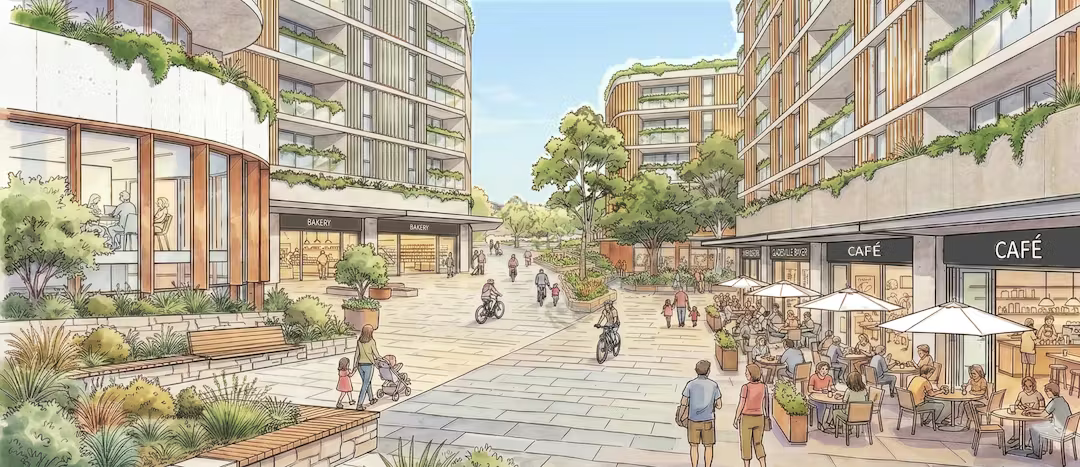
You should know that this picture doesn't have any relevance to the master plan. It's just an artists rendering of what a generic communal area would look like, but this doesn't stop Council using it as the salient image on the project's page. The detailed visual designs for the new shopping village don't exist yet, they can't, you don't waste money designing it when you can't legally build it because the FSR is too low.
We'll take a moment to understand the two numbers. Council were given a target of 400 new dwellings. Why am I saying there's going to be 522 apartments? The answer is in the economic feasibility study.
Council ran an economic feasibility study and it turns out this development might not be that easy. You see, in order to be palatable to any developer a development would need to deliver a profit. Profits are good, business is business and I'm not against people making money. But it turns out that projects like this are only worth proceeding if you can make a certain amount of profit. Per the HillPDA Economic and Feasibility Assessment:
At FSR 4:1 project feasibility improves showing both the development margin and project IRR achieving 9.5% to 10%. These levels remain a little below target. However sensitivity testing shows that with an improvement in end sale values of around 5% the development margin increases to 15% and the project IRR to 13% which begins to look possible.
Right now the project could make about 10% IRR (Internal Rate of Return), which is a measure of how profitable a development is over its entire lifecycle expressed as an annualised percentage. The sensitivity testing mentioned in the extract above is an obfuscating term that describes an arbitrary change in the variable used to calculate the outcome. It means "when we pretended that property values rose 5%, without any view that this would really happen, we see profits rise to the point a developer would build this". Citing outrageous post-COVID construction costs this development is not viable without adding aspirational sale values to a spreadsheet.
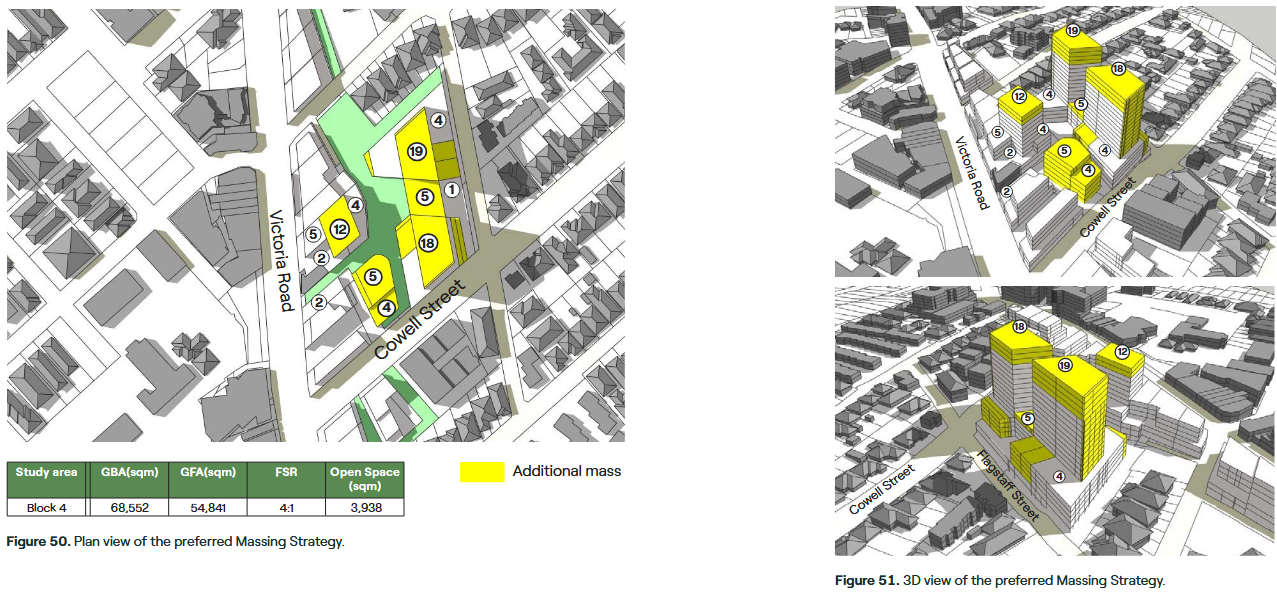
Let's talk height for a moment. We've spoken about Floor Space Ratio, profit, but now the nuts and bolts: what would this actually look like if someone builds it? Well, here you go. The preferred "Massing Strategy" extracted from the master plan for you.
And here's the shadows created...
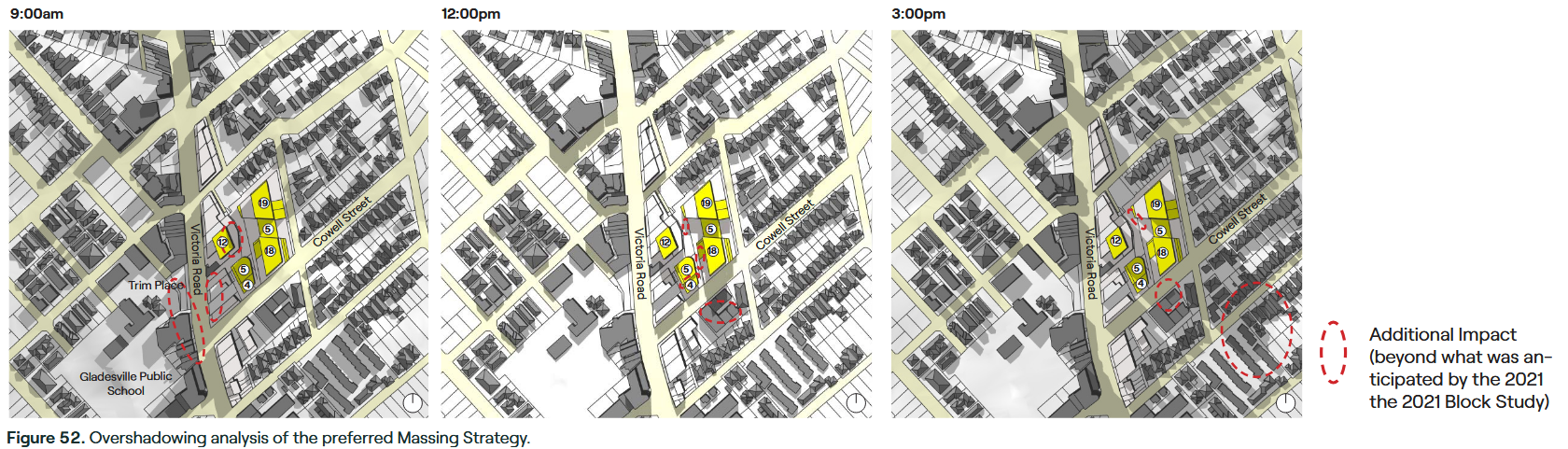
The shadows wont bother anyone that doesn't live near them, which is important to note considering that most residents of the Hunters Hill LGA live off in Hunters Hill, Henley, and Woolwich where there are currently no major proposed housing developments. The plan is clear: use the Gladesville Shopping Village site to meet the new housing requirements and leave the peaceful affluent of the quieter suburbs alone.
This speaks to a larger inequity issue evident in the area. Council just don't care about the little limb of Gladesville they're responsible for. You only have to look at the Love Gladesville Facebook page to see how they're failing Gladesville (if the admins don't delete your post). One person surveyed for this article reminded me that it took numerous weeks of pressure to motivate Council to simply clean the footpaths on Victoria Road, but if you went down to the Hunters Hill Village area it is consistently spotless. Just look around the area and you'll see that Council willfully neglect their obligations to Gladesville. Woolwich looks gorgeous today though.
What better way to "fix" Gladesville than to turn it in to a high density slum and ultimately tie it off by handing it over to Ryde council in good time.
What about the long term impact of building 522 new apartments in one place?
We don't know much about that because every party involved is doing the bare minimum documentation and effort required. The NSW Department of Planning required Hunters Hill Council to consult with Transport for NSW before issuing their gateway decision on the planning proposal. The outcome of the Transport Impact Assessment is essentially "don't worry about it". The only substantial suggestion is tactile indicators for the visually impaired. They didn't address bus capacity, they didn't study service reliability or the impact of the 500X starting in Parramatta (instead of West Ryde). The development actually relies on encouraging people away from cars to reduce the amount of parking required. The plan suggests selling apartments with no parking spaces available and TfNSW don't think they'll need to add bus capacity for the AM and PM peak.
This is a mess of laziness and appeasement.
I can only hope the opposition to this is thoughtful enough to move beyond the perception that people are objecting to tall buildings and change. The Not In My Back Yard mindset of Gladesville residents is easy to blame if you are on the outside looking in to Gladesville. What we're really looking at is a serious change to the landscape of Gladesville that will have repercussions for decades if we aren't careful.